Wallowa County reports major progress and new threats in invasive weed species battle
By Tracy Christopher on Friday, April 10th, 2026 in More Top Stories Northeastern Oregon News
ENTERPRISE — The Wallowa County Weed Board and its regional partners recently presented a comprehensive update to County Commissioners, detailing a high-stakes effort to protect the local ecosystem from aggressive invasive species. The 2025-2026 reporting period highlighted a multi-agency strategy involving the Tri County Weed Management Area, Wallowa County Weed Department, Oregon Department of Agriculture (ODA), The Nature Conservancy (TNC), Wallowa Resources, and the Wallowa-Whitman National Forest.
A Record Year for Containment and Landowner Support
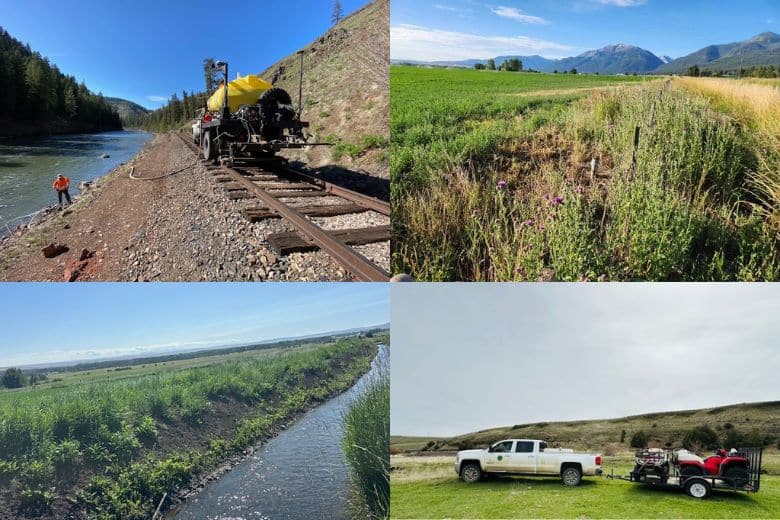
The Wallowa County Vegetation Department reported significant treatment milestones, successfully managing 660 net acres of “A” and “T” listed weeds, and over 1,418 net acres of “B” listed species. Infrastructure protection remained a priority, with 270 acres of County Road right-of-ways and 220 acres of Wallowa Union Railroad Authority (WURA) lines treated.
To support local residents, the county increased its cost-share contributions to landowners by $6,000, totaling over $21,486 for the current cycle. The agricultural impact extended to certification services, with the department certifying 70 tons of hay and 10 tons of straw as weed-free.
High-Tech Warfare on the “A-List”
The battle for Wallowa County is unique because it hosts several species found nowhere else in the region.
- Welted Thistle: Wallowa County is home to the only Welted Thistle site in the Western United States. While no seed production has been recorded since 2016, a new site was discovered in 2025 within a third of a mile of known infestations, prompting an immediate “pull and bag” eradication effort and scheduled surveys for 2026.
- Turkish Thistle: This rare invader exists outside its native range only in a limited area of Hells Canyon. ODA and USFS staff coordinated spring treatments in 2025 to contain its spread.
- Technological Innovation: The Nature Conservancy (TNC) utilized advanced drone technology for aerial monitoring and treatment of Medusahead Rye. TNC reported spending $25,000 on contracted treatments and dedicated 459 hours to weed management on the Zumwalt Prairie Preserve.
Engaging the Next Generation of Stewards
Beyond herbicide and drones, the Weed Board is invests in outreach such as yearly presentations that engage elementary students in Wallowa County schools. The “Dirt Babies” program engaged elementary students in Wallowa and Joseph, while the debut of a new Tri-County education trailer at the County Fair provided residents with hands-on identification tools.
The 2026 roadmap includes a “Thistle Field Day,” at Wallowa Elementary, and a targeted “Weed Wipeout” event for Spotted Knapweed in Joseph.
Looking Forward to 2026
The coming year will see an expansion of surveys on Crow Creek and the Little Sheep Corridor, alongside new projects targeting Scotch Thistle and Leafy Spurge along railroad lines between Enterprise and Lostine. Federal support remains critical, with the Wallowa-Whitman National Forest planning to apply for $100,000 in Bipartisan Infrastructure Law (BIL) funds to continue these vital restoration efforts.