Wallowa County advances major update to Community Wildfire Protection Plan
By Tracy Christopher on Friday, December 12th, 2025 in More Top Stories Northeastern Oregon News
WALLOWA COUNTY — After 18 months of steady work, the multi-agency team responsible for updating Wallowa County’s Community Wildfire Protection Plan (CWPP) presented a detailed progress report to the county commissioners at last week’s county commission meeting, outlining what they described as the most community-informed version of the wildfire plan to date.
The update—last completed in 2017—has involved a core group of representatives from county staff, Wallowa Soil and Water Conservation Service, Oregon Department of Forestry (ODF), the Oregon State Fire Marshal’s Office, Wallowa Resources, US Forest Service, and members of local Firewise communities. The group has been meeting monthly since June 2024 to develop the new 10-chapter plan.
“This is essentially our countywide to-do list,” said Elena Cussler, acting Forest Program Manager at Wallowa Resources. “The CWPP is not regulatory. It is a community-driven roadmap for wildfire resilience, and it is the tool that helps us secure funding to actually do this work.”
An Extensive Public Engagement Effort
This year’s update included one of the most comprehensive local outreach efforts ever conducted for a CWPP. The county mailed wildfire surveys to every property owner in a tax statement mailing and hosted three public mapping meetings at Hurricane Creek, Lostine, and ODF’s Wallowa office. Residents were invited to mark maps with sticky notes identifying hazards, access challenges, defensible space needs, water sources, and areas where fuel reduction would help.
“It was extremely informative,” said Firewise Coordinator Jenny Reinheardt. “People pointed out everything from congested driveways to safe turn-arounds. In one case, someone even marked where teenagers tend to have summer campfires—the input was valuable.”
All community feedback was compiled into a detailed, color-coded dataset the committee is now using to shape priorities.
A Non-Regulatory Tool That Unlocks Funding
Regional wildfire specialist Chris Paul of the Oregon State Fire Marshal’s Office explained that CWPPs differ from more formal FEMA hazard plans.
“CWPPs are flexible. The requirements are minimal, and they truly reflect what communities want,” Paul said. “But they are also the backbone of major federal grant applications. The updated plan ensures Wallowa County is eligible and competitive.”
He noted that recent federal Infrastructure Investment and Jobs Act funds—the “Biden bucks,” as some call them—significantly increased demand for updated CWPPs. Successful grant proposals must now tie directly to documented projects in a current plan.
The county is already seeing results. Reinheardt recently secured a $5.25 million Community Wildfire Defense Grant, one of the largest in county history, supported heavily by the existence of the 2017 CWPP and the ongoing update.
What the Updated Plan Will Emphasize
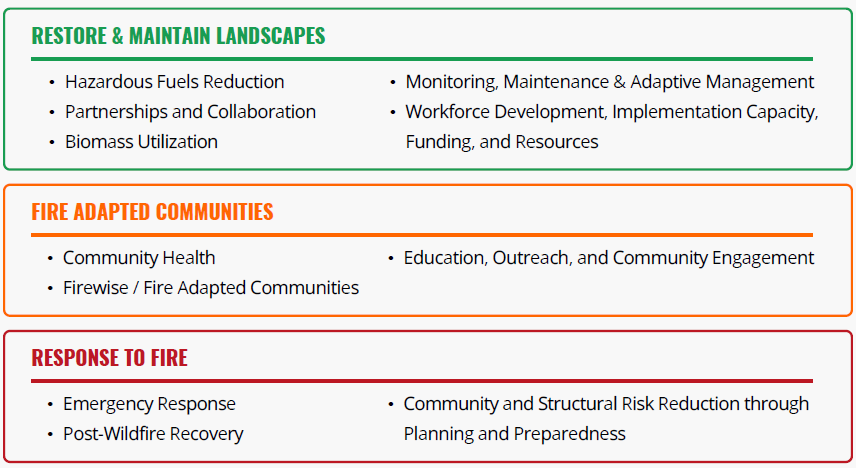
The new CWPP divides wildfire resilience efforts into multiple categories, including restoring landscapes, fire-adapted communities, home hardening, emergency response, and long-term monitoring.
One major item under discussion is the creation of a multi-agency, cross-boundary tracking system for fuels treatments. Agencies such as ODF, NRCS, the U.S. Forest Service, all conduct thinning, burning, and monitoring work. A shared database would help coordinate maintenance and “re-entry” treatments when vegetation regrows.
Another high-priority component is expanding Firewise communities and defensible-space education. “Firewise benefits everyone, not just those inside Firewise boundaries,” Reinheardt said. “The goal is a fire-adapted Wallowa County.”
A Timeline Toward Completion
The CWPP committee is finalizing edits on the plan’s ten chapters. Commissioners will receive chapters in batches in the coming month to avoid a single overload at the end of the process.
By April, design and layout work will be underway, and the plan is expected to be ready for final approval in May.
“This update reflects local knowledge, local concerns, and local priorities,” Cussler said. “It’s a tool built by Wallowa County, for Wallowa County.”