Over half of Union County now under extreme drought. Governor declares emergency
By Garrett Christensen on Tuesday, July 14th, 2026 in More Top Stories Northeastern Oregon News
UNION COUNTY – Northeast Oregon, including Union County, is continuing to see drought conditions as the hot summer season drags on and precipitation remains minimal. On Wednesday, June 24, the Union County Board of Commissioners officially declared a drought emergency, per the recommendation of Union County Emergency Manager Nick Vora.
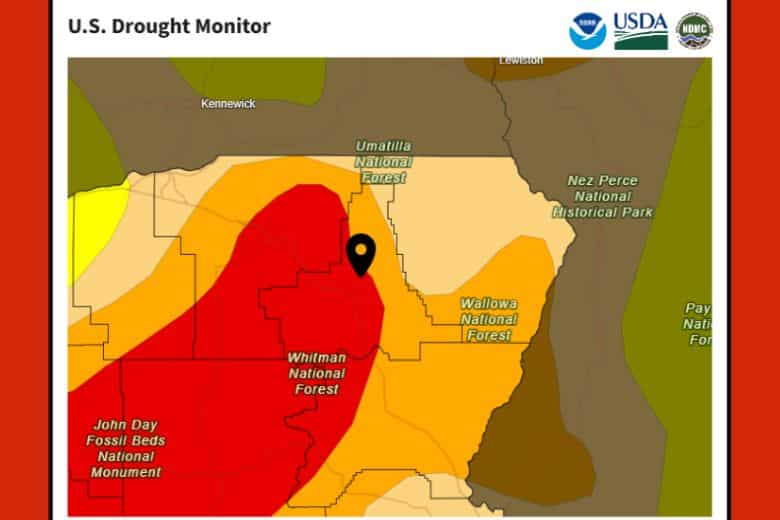
At the time, a staff report from Vora indicated approximately 77% of Union County by area was under Severe Drought (D2) and 17% in Extreme Drought (D3), based on U.S. drought monitor data. The region has continued to dry as The National Integrated Drought Information System (NIDIS) reports that as of July 7, over half of Union County by area is experiencing Extreme Drought.
Specifically, the U.S. Drought Monitor reports that 55.50% of Union County land is classified as being under Extreme Drought, while 40.68% is listed as under Severe Drought, and the remaining 3.82% of land is under Moderate Drought.
Further, according to NIDIS, over the past 60 days, precipitation has largely been listed as 25%-50% of normal compared to the average. Temperatures across the county over the past 30 days are recorded as generally 1-4 degrees above normal, with a handful of areas listed as 4-6 degrees above normal.
In response to these conditions and prior local declarations, Oregon Governor Tina Kotek officially declared a drought Emergency for Both Union and Curry Counties yesterday. The full press release from the governor’s office is as follows:
(Press release from Oregon Governor Tina Kotek’s Office)
Governor Tina Kotek has declared a drought emergency in Curry and Union counties through Executive Order 26-12 and directed state agencies to coordinate and prioritize assistance. The Executive Order is available here.
This marks the sixth drought declaration order issued in 2026. In total, 21 of Oregon’s 36 counties are now under drought emergency status. According to the U.S. Drought Monitor, Curry and Union counties are experiencing moderate to extreme drought conditions. Seasonal climate and drought outlooks indicate that drought conditions in the counties are likely to persist.
Curry County
As of June 30, all of Curry County is in moderate to severe drought. Standardized Precipitation Evapotranspiration Index (SPEI) values over the water year-to-date (WYTD) correspond with moderate to severe drought for most of Curry County.
Union County
As of June 30, all of Union County is in some form of drought. 96% of the county is in severe to extreme drought, with extreme drought accounting for 41% of the county. SPEI values over the WYTD correspond with moderate to extreme drought for most of the county.
Impact and State Response
Drought conditions are expected to significantly affect Oregon’s farms, ranches, recreation and tourism sectors, drinking water availability, fish and wildlife habitats, and other natural resource-dependent activities. Extreme dryness will likely shorten the growing season, decrease water supplies, and increase wildfire risk.
The drought declaration unlocks emergency tools for affected communities, including assistance for local water users and expedited review processes through the Oregon Water Resources Department (OWRD).
In March, the Governor declared drought in Baker, Deschutes, and Umatilla counties, pursuant to Oregon Revised Statutes (ORS) 536.740, followed by a declaration in April for Crook, Grant, Jackson, Jefferson, Morrow, and Wallowa counties; a declaration in May for Coos, Klamath, and Wheeler counties; a declaration on June 10 for Douglas, Gilliam, Harney, Lake, and Malheur counties; and a declaration on June 24 for Josephine and Wasco counties. The Oregon Water Supply Availability Committee and state natural resource partners continue to monitor water conditions closely.
As state and local officials coordinate with federal and Tribal partners, conditions will be closely monitored by the state’s natural resource and public safety agencies, including the Oregon Water Resources Department (OWRD) and the Oregon Department of Emergency Management (OEM).