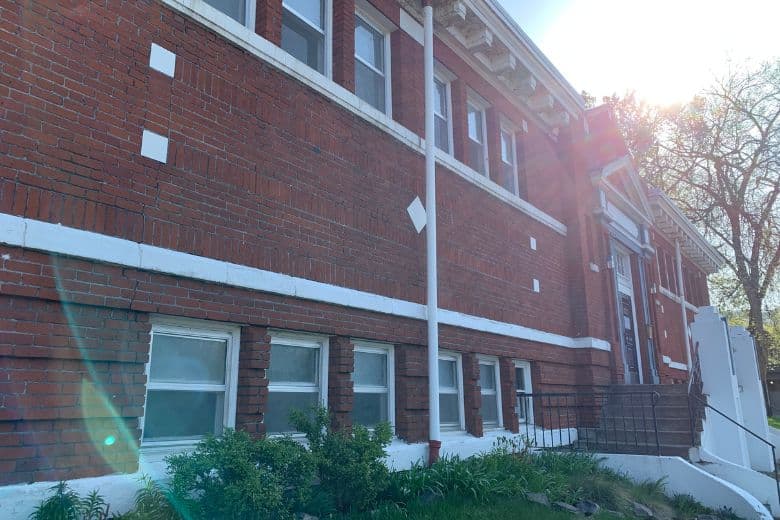
Oregon recommends La Grande’s Carnegie Library be added to the national register of Historic Places
By Garrett Christensen on Monday, February 23rd, 2026 in More Top Stories Northeastern Oregon News
LA GRANDE – La Grande’s historic Carnegie Library building just completed a major step toward extensive restoration and preservation. During a meeting on Thursday, February 19, the Oregon State Advisory Committee on Historic Preservation, under the Oregon Parks and Recreation Department, approved a formal recommendation that the library be added to the National Register of Historic Places. The building’s application to the register will now be forwarded to the Keeper of the National Register for federal approval.
For those unfamiliar with its history and the project, the La Grande Carnegie building was originally constructed in 1913. One of 1,689 such Carnegie Libraries built in the United States between 1816 and 1919 (according to the U.S. National Parks Service), including 31 in Oregon, it served as the La Grande Public Library all the way through September 2006, retiring in this capacity with the construction of the Cook Memorial Library. Currently, the building is one of only a handful of Carnegie Libraries remaining in the United States that have not been listed as a historic landmark on the National Register of Historic Places.
The City of La Grande has been working to have the building added to the register for several years, allocating funds in early 2024 to formally research and draft a nomination to the register. If approved, the building would become eligible for new grant opportunities to restore and preserve its facade and other historical elements.
During the meeting, members of the committee commented extensively on the building largely adhering to its historical condition and layout, as well as its historical and cultural significance to the La Grande community. In particular, Kara Brunzell with Brunzell Historical, who worked with the city to develop the proposal, emphasized the importance of the La Grande community coming together in 1913 to see the library built.
In an era of classical revivalism, where smaller communities across the nation were attempting to elevate themselves civically and educationally, the library provided a unique opportunity for easy access to literature, in addition to being an important local hub for the small town. Further emphasis was placed on the Carnegie Libraries as a whole in setting a new standard for public libraries in terms of design and public accessibility.
The sentiment was echoed by committee member Sarah Munro, who took the lead in reviewing the proposal. Munro remarked on the library’s importance in promoting civic engagement, free access to information, and fostering an informed citizenry. The narrative put forward in the proposal, in general, kept in line with similar Carnegie Libraries across the country and Eastern Oregon.
The committee did have some feedback and concerns on the proposal, however. Munro commented that the application could have pushed the democratic/civic engagement aspect more. Committee member Heidi Slaybaugh, along with several other members, also expressed that a more extensive visual comparison with other Carnegie Libraries (particularly Enterprise’s) should be included.
Other concerns brought up included the need for more information on minor structural and visual elements, the correction of discrepancies with descriptions of the building’s fireplaces (particularly with their reinforcement work in 1982), and a dislike of the building having an art deco twin front staircase instead of its original classical single staircase.
Some questions were also raised by committee member Steve Mark about the ethics of Andrew Carnegie himself and whether local media at the time brought up these concerns when the library was originally being sought. Overall, however, the committee was satisfied with the proposal.
With the recommendation now being forwarded to the federal level, the committee will work with Brunzell Historical to make changes and improvements to the proposal. A date for final consideration to the National Register of Historic Places has not been set as of the time of writing.