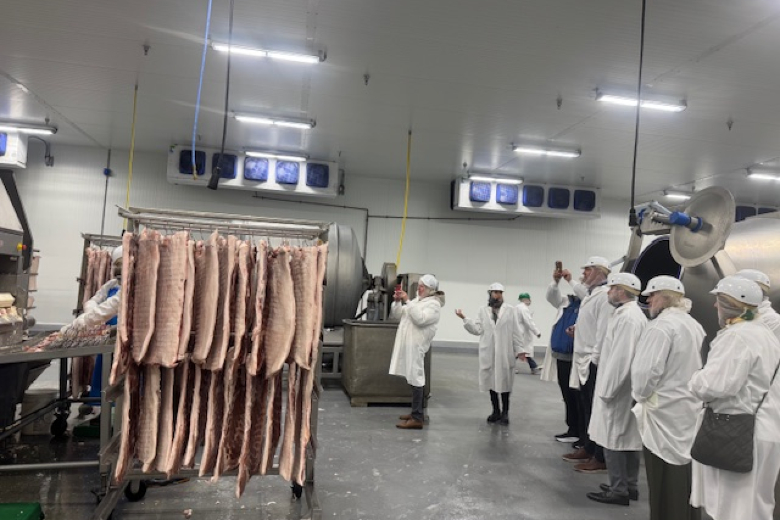
Oregon Prosperity Council hears from local businesses during Pendleton visit
By Griffin Beach on Thursday, April 16th, 2026 in Columbia Basin News More Top Stories
PENDLETON – The Oregon Prosperity Council visited Pendleton on Wednesday, stopping for a tour of Hill Meat Company, a local pork processing operation owned by Jim Cheney and his three daughters.
The council was formed in January to advise Gov. Tina Kotek on actionable steps to accelerate the state’s economy, create well-paying jobs, and recruit and grow Oregon businesses. Following the tour, the council met with local business owners before holding an official meeting at Pendleton’s unmanned aerial systems (UAS) facility.
“Spending some time with some local businesses, just hearing from them of what are the drivers of your business and what’s working in terms of state policy,” said council co-chair Curtis Robinhold, who also serves as the executive director for the Port of Portland.
The other co-chair, Renee James, founder of Ampere Computing, said that while the council gets an inside look at successful businesses, it is equally important to hear their concerns.
“The themes are consistent; concerns that they have about the future around tax, some of the other Oregon approaches that are not as competitive as other states, opportunities that are being presented to them to go other places if they had the means to move,” James said. “Those themes will form the recommendations to the Governor.”
Cheney was direct with the council regarding the regulatory challenges his business faces. He said his message to the governor is to prioritize solutions over revenue.
“Her job is not much different then mine; if you’re running a business you’re a problem solver and that’s most of your energy,” Cheney said. “You can’t just raise taxes and solve something, you’ve gotta fix the problem.”
James noted that the council has heard similar sentiments across the state regarding taxes, permitting, and land availability as hindrances to growth.
“There’s still a lot of challenges that have to do with the structure of how Oregon has layered on taxes,” she said.