NTSB releases preliminary report into helicopter crash that killed 4 Oregonians
By Dan Thesman on Wednesday, January 21st, 2026 in Columbia Basin News More Top Stories
PINAL COUNTY, Arizona – A preliminary report released by the National Transportation Safety Board (NTSB) has revealed that a helicopter crash that killed four people from Oregon on Jan. 2 was caused by an impact with a “highline” suspended hundreds of feet above a valley floor.
The MD Helicopters MD369FF was traveling through a valley near Superior, Arizona, at approximately 10:00 a.m. Pacific standard time, when it struck a synthetic webbing line rigged between two bluffs for the sport of highlining – a high-altitude version of slacklining.
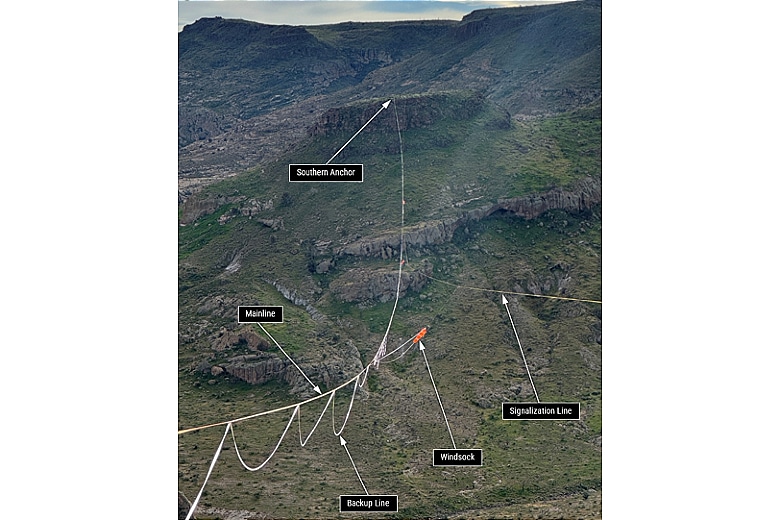
Photo via witnesses shows the series of lines between the anchors, as viewed from the northern bluff
According to investigators, the pilot, David McCarty, 59, of Baker City, and three passengers, his nieces, Rachel McCarty, 23; and Faith McCarty, 21, both from Echo; and Katelyn Heideman, 22, from Hermiston, were killed. The flight was being operated as a personal trip just hours before David McCarty was to be married.

Witnesses at the scene, who were part of the group that rigged the line, told investigators they had been in the process of raising the mainline and backup line between two anchors spaced nearly three-quarters of a mile apart. The lines were estimated to be roughly 600 feet above the ground at their highest point.
One witness near the southern anchor reported seeing the helicopter flying east at “eye level.” The aircraft briefly disappeared behind terrain before reappearing and flying directly into the suspended lines. Upon impact, the helicopter reportedly pitched nose-up and yawed to the right before its tail boom separated from the fuselage.
The wreckage came to rest in the rugged terrain between 150 and 350 feet from the lines.
Evidence found at the crash site confirmed the helicopter’s contact with the sporting equipment. NTSB investigators found material consistent with slackline webbing embedded in the vertical stabilizer. Striations matching the weave pattern of the nylon lines were also discovered on the paint of the stabilizers and two of the main rotor blades.
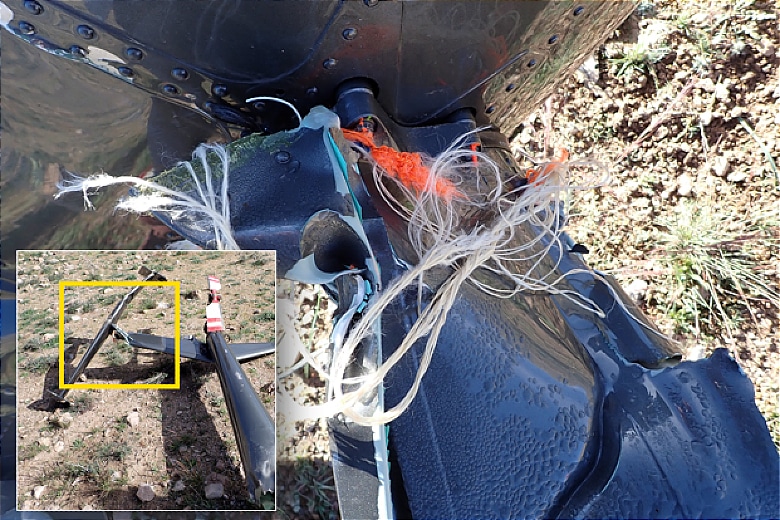
Photo via NTSB shows highline/slackline webbing imbedded in the vertical stabilizer.
Notably, the helicopter was equipped with a wire strike protection system designed to cut through cables. However, investigators noted that the cutting surfaces showed no signs of disturbed paint or striations, suggesting the system did not engage or was ineffective against the synthetic webbing.
The investigation found that a Notice to Airmen (NOTAM) had been filed on Dec. 21, by a friend of the slackliners. The notice warned of a “tight rope” approximately three nautical miles south of Superior Municipal Airport. The NOTAM was active at the time of the accident.
Despite the tragedy, the danger remained present shortly after the crash. First responders reported that about an hour after the accident, a second helicopter flying a similar path passed within 10 feet of the remaining signalization line, which stayed suspended along with fragments of the slackline.
The NTSB has retained the wreckage and sections of the webbing for further examination as the investigation continues.
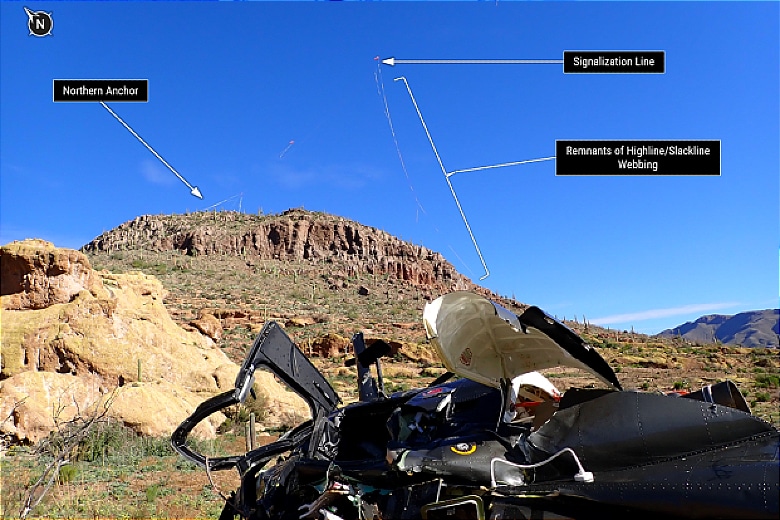
Top photo via NTSB shows the helicopter fuselage with the northern bluff, signalization line, and sections of the highline/slackline are visible in the background.