Living and learning with fire, Joseph students participate in Smithsonian documentary on prescribed burning and land stewardship
By Garrett Christensen on Monday, November 3rd, 2025 in More Top Stories Northeastern Oregon News
JOSEPH – Though undoubtedly destructive, fire is a nonetheless common and, at times, beneficial element of many environments. Whether prescribed or naturally occurring, cycles of overgrowth and burning are common across forests in the Pacific Northwest. Like with any land management practice, adequate education and hands-on training are crucial to ensure the next generation of firefighters and foresters are adequately prepared. One group of students in a remote corner of Northeast Oregon are not only receiving a uniquely in-depth form of prescribed fire training but have secured a place in the Smithsonian Museum of Natural History for their efforts.
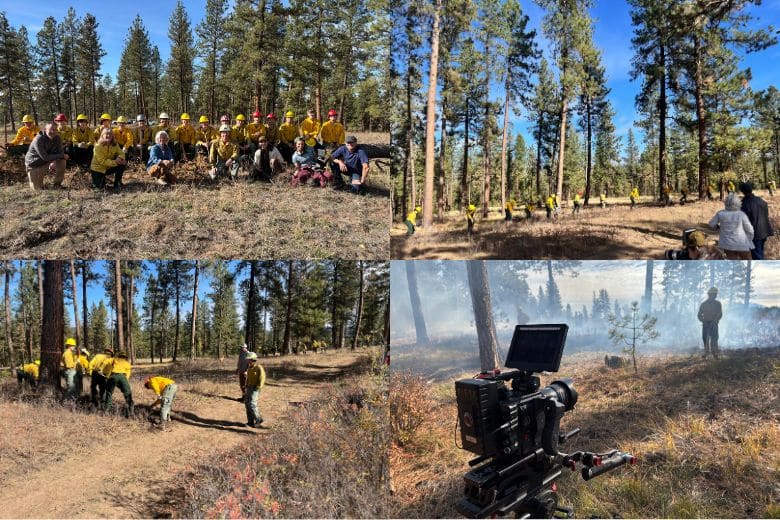
The Joseph Fire Science class, as the name implies, gives students at Joseph Charter School a detailed examination of fire as a land management tool, offering both college credit and a level of consistent hands-on experience that is entirely unique for Eastern Oregon. Taught by Olan Fulfer, one of the class’s more recent projects saw the students prepare a small but nonetheless fully planned prescribed burn on private property in collaboration with Oregon State University.
Around sixteen students conducted the prep on September 24, 2025, initially digging fire line around the planned burn, before moving through and thinning trees in the area and hauling the brush off. The class returned on October 8 to assist with the actual burn, a first for the students. As explained in detail by Joseph senior Jonah Lyman
“First, we dug line to ensure that the burn would not escape from where we wanted to burn. Then, we also went through with chainsaws and thinned a lot of the trees, spaced them out, and cut down trees that we didn’t want there, just to make the forest healthier. Then, we lit everything on the ground and the fire just ripped through all the grass, burnt the whole understory, and cleaned everything up. It got rid of all the small brush on the ground and left all the big trees. All the trees that we thinned and wanted to leave were healthy and left untouched.”
The team from OSU would document the project for educational purposes, and it’s this footage that eventually caught the attention of representatives from the Smithsonian. Two weeks after the burn, the Smithsonian reached out to the class with an opportunity to be involved in a documentary titled “Living with Fire,” which, appropriately, focuses on the productive use of fire as land management tool and how teenagers are being educated on environmental management. As explained by Joseph senior Isacc Deachy:
“It’s about spreading awareness. Most people think that fires just destroy stuff and it’s kind of a bad thing, but we have to rejuvenate our forests and it’s about getting people to see that.”
As part of the documentary, the class would return to the same property and conduct a second, albeit smaller, burn on Thursday, October 23, including more line digging and much of the same prep work. The team from the Smithsonian Museum filmed and documented this second burn, while members of the Oregon Department of Forestry Wallowa Unit participated to provide additional instructions and training. As was written by ODF in a recent social media announcement:
“For the project, students reenacted a prescribed burn conducted a few weeks earlier on a local landowner’s property. The class gained valuable hands-on experience by building a handline, conducting firing operations, and performing tree thinning work.
The ODF Wallowa Unit partnered with the class to provide instruction on handline construction, firing techniques, and fireline safety.
This collaboration highlights the importance of education and training in helping the next generation understand and safely work with fire on Oregon’s landscape.”
As mentioned, the prescribed burns, in addition to contributing to the documentary, were a first for the students. When returning to the property to conduct the second burn, the class were able to see firsthand the impacts of a prescribed burn and the immediate environmental recovery. As described by Joseph senior Grayson Hawkins:
“After we came back for the reenactment for the documentary, we could see small grass shoots. There was a bunch of grass already starting to sprout up. It was pretty cool to see that we were able to help out the forest like that.”
In addition to giving the class the opportunity to participate in the burn, the property owner also pledged to donate money to help sponsor five kids in Tanzania. As reflected by senior Robert Nichols:
“My favorite part is that we were able to do this for landowners, but not only are we helping our local environment, the landowner donated to charity. So, we were able to be a part of that and support some kids in Africa as well. We helped our local community and community abroad.”
Longterm, the documentary itself will be part of a larger exhibit in the Smithsonian Museum of Natural History in Washington DC. Fulfer hopes to organize a fundraiser later so the entire class can visit the exhibit during its debut. According to a representative from the Smithsonian, the video will play in the Age of Humans Gallery in the Deep Time Hall alongside other videos focusing on improvements to land stewardship over the years. Reflecting on his class’s work, Fulfer remarked:
“I am so proud of the class for all of their hard work they have put in to have this opportunity and that they absolutely earned it. Half the class is involved in community service and they all come to class prepared every day and work hard with great attitudes always, whether it’s splitting and stacking wood, gardening, raking leaves or shoveling snow.”