Alarming ambiguity? Forest Access For All weighs in on the Blue Mountain Forest Plan Revision
By Garrett Christensen on Tuesday, September 15th, 2026 in More Top Stories Northeastern Oregon News
NORTHEAST OREGON – For years, discussions have waxed and waned on the current methodology of land management in the Pacific Northwest, and how to strike a balance between environmental conservation, public land access, and commercial timber usage. More recently, debate has surrounded the pending Blue Mountain Forest Plan Revision, which will drastically overhaul the original, aging, forest plans for the Malheur, Umatilla, and Wallowa Whitman National Forests. With the public comment period nearing its September 30 deadline, advocacy groups across the region are weighing in and encouraging public involvement, including Forest Access for All.
For those unfamiliar, Forest Access for All (FAFA), is a Baker City Based organization that, per the description of its president, Don George, “advocates to maintain access for all users of public lands.” This advocacy includes focuses on both economic and recreational elements, with the organization often being labeled as a motorized access group.
Like many groups in Eastern Oregon with an interest in public lands, FAFA is in the thick of the conservation vs access debate, with fears that the current iteration of the Blue Mountain Forest Plan Revision leaves too much room for interpretation and is insufficient in its management guidelines. As described by George in a recent interview with Elkhorn Media Group:
“Our opinion broadly is that this proposed forest plan is not a sufficient plan for the future. It comes up short with its goals, and we don’t believe that it encourages good stewardship of the lands, nor does it encourage active management of the lands. So that affects all aspects of public land use, whether it’s wildlife, vegetation, timber management, road access, or recreational uses. And that’s really what we’re trying to get out of this, is a solid plan that’s going to give us active management and good stewardship of the lands in the future.
When asked more specifically why FAFA saw the plan as insufficient, George listed a myriad of concerns, though the primary was the option that the draft is too vague and directionless in its policies, particularly when it comes to travel management and road access. Without exact standards or hardline policies to reference, FAFA’s fear is that this will lead to a pendulum effect of increasing and decreasing access regulations at the local level and will make giving input to the Forest Service on future projects more difficult.
Other concerns raised by George and FAFA related to active forest management and timber harvests, with George claiming that the new plan has a 60% reduction in timber harvest goals for the Wallowa Whitman National Forest alone compared to the 1990 iteration, with some alternatives seeing even less. As remarked by George:
“The goals they have set in this draft plan appear to be set on what they are currently treating. What they’re currently treating we don’t feel is sufficient to improve the health of the forest on the scale that it needs.”
Oddly, George noted that the vague language concerns aren’t strictly related to access advocates, but even some conservation groups may be taking issue with the lack of specific goals and policies. That said, longterm, FAFA remains concerned that the plan as currently drafted will open the door to restrictive travel management and limitations on public land access, with George remarking:
“With this forest plan, there’s no guardrails to guide them on their path to implementing travel management. We know from experience with other forests that travel management at the very best will cut out half or more of motorized access, or it could be up to 90% restrictions of motorized access. We feel that one, it’s not necessary to have those kinds of restrictions on these three forests, two, it’s going to be severely detrimental to the welfare of the communities, and three, it’s going to be detrimental to the tourism that these communities see.”
Page 177 of the current Preliminary Draft Proposed plan (which can be found here) lists the following possible actions for motorized access under Appendix-B, the “Transportation Infrastructure” section:
Transportation Infrastructure
Road actions serve to maintain and improve the national forest transportation system to enhance recreation opportunity, provide administrative access for resource management, and reduce negative impacts on ecosystems and natural and cultural resources. Actions may Include:
- Supporting permanent road construction and temporary road reconstruction Actions.
- Implementing measures (such as education, signage, law enforcement, or seasonal road closures) to discourage encroachment of motorized vehicles into non- motorized areas.
- Conducting annual road maintenance on existing roads and implementing emergency repairs necessitated by natural events
Of course, the ethics and necessity of motorized access and to what extent should public land remain restricted for the sake of preserving environmental health remain hotly debated between groups like FAFA and more conservation-oriented organizations. In recent weeks, as the public comment phase of the new plan has picked up, some groups have criticized FAFA for advocating for recreational motorized access at the expense of the landscape and animal herds.
Countering some of the claims, George argued that FAFA is both not exclusively advocating for motorized access, but all forms of public land access, and that motorized access has more utilitarian benefits beyond pure recreation, such as allowing access for fuels treatment, timber harvesting, and wildlife studies, among others. In particular, George pointed to the need for maintained forest roads and access options for heavy equipment during firefighting operations and the time and resource sink required to quickly recondition roads during an active fire, remarking:
“When there’s a forest fire, the roads are all closed, they’re barricaded, they’re decommissioned, however they’re dealt with. Before they can get equipment in to fight that fire, they have to wait until a dozer can show up to open that road back up. That delay enables the fire to get much, much bigger.”
Regarding criticisms of harming animal populations, George and FAFA maintain the position that motorized access within the Blue Mountain region results in minimal detrimental effects on animal populations, and that deer and elk herds will adapt to a human presence in their environment, or in some cases already have. One example pointed to is the recent overpopulation of deer in and around the City of Union, with George claiming that the animals, due to their close proximity, remain mostly indifferent to humans and only became aggressive toward property and pets when their population hit a point such that they were actively competing with each other.
While acknowledging that access infrastructure and human activity can cause animal herds to shift, FAFA further maintains that the largely nomadic nature of herd species like deer and elk means these movements will not be deleterious long term. Elaborating more, George explained FAFA’s position that Northeast Oregon’s national forests have, “a fraction of the people on the landscape at any given time,” and that the limited human presence compared to forests closer to metropolitan areas or with traditional heavy tourist traffic further limits the possible impact of motorized access.
This further leads to broader concerns that there is simply a misconception on how local communities interact with federal forest lands, and how monolithic policy without local nuance could affect said communities going forward, with George remarking:
“The current regulations are set up to be implemented unilaterally across the entire U.S. but depending on the areas, some of those regulations just don’t work for those communities and don’t work for those forests. So, the regulations really need to change so that the local management can tailor their plans and their activities around what is needed, not just whatever DC has decided.”
Part of the issue, according to George, may come down to a lack of experience in different forest management doctrines by policy makers, with him pointing to Idaho’s more hands-on approach for travel management and timber harvesting as an example that could be followed. Another issue is the misconception of how dependent some communities are on forest access. In addition to public land recreation being a key piece of Eastern Oregon’s tourism, many residents actively depend on the land to sustain themselves.
As many locals are likely familiar with, it’s not uncommon for households, particularly in more remote and unincorporated communities, to hunt and fish as a genuine food supplement or as a form of income, along with activities like gathering firewood being common. While the exact impacts on these activities remain up to debate, FAFA maintains concerns that limitations (or at least unclear management policies) for motorized access could impact far more than recreation.
As mentioned, the comment period on the Blue Mountain Forest Plan Revision remains open through Wednesday, September 30th. For anyone interested in giving feedback, FAFA has created a dedicated public comment tool, where residents select topics and information important to them to generate a comment, with the option to modify the final draft as they see fit. FAFA’s comment tool can be found here: https://www.forestaccessforall.org/bmfpr-public-comment?fbclid=IwY2xjawUVDVFwZG9mAWV4dG4DYWVtAjEwAGJyaWQRMXVnWVpMU0xLNzlIYlFQeExzcnRjBmFwcF9pZBAyMjIwMzkxNzg4MjAwODkyAAEehFqWvd8Wp0d1ti0pkP9CZcD0A71AORmn0f2tfZ-Bs4NDX8n4kK_jWgyY2wM_aem_lEJGyg3w7k7Eea1A7zyRvA
Comments on the plan can be submitted directly to the Forest Service online, via email, or by mailing a letter to the USFS Umatilla National Forest Supervisor’s Office. As posted by the Forest Service:
- The 90-day public comment period will be open July 2, 2026 to September 30, 2026. Submit your comments using one of the following:
- Online through our Comment Analysis and Response Application (CARA) database at https://cara.fs2c.usda.gov/Public/CommentInput?Project=301397.
- Send a written letter to: Umatilla National Forest Supervisor’s Office, Attn: Blue Mountains Forest Plan Revision, 72510 Coyote Road, Pendleton, OR 97801
- Send an email including an attached written letter to sm.fs.bluesforests@usda.gov.
- View the How to Comment handout for further commenting information.
More information on the plan, including comment links and all publicly available documents from the Forest Service, can be found here: https://www.fs.usda.gov/r06/umatilla/planning/blue-mountains-forest-plan-revision
**
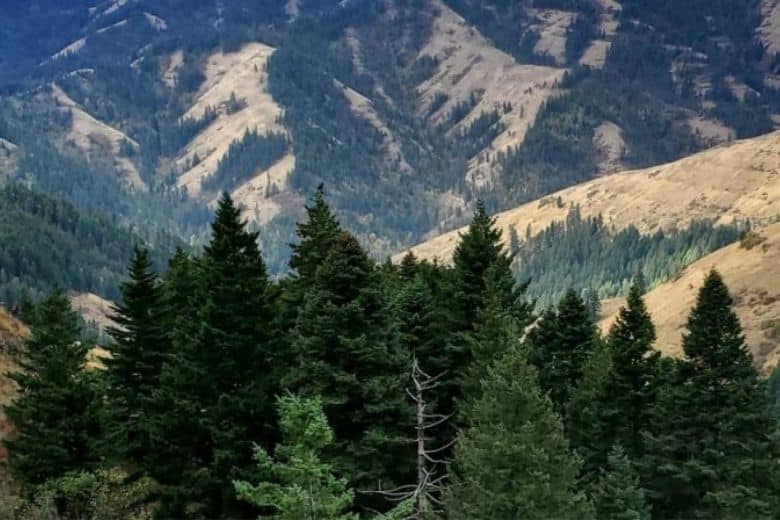
(Photo from the Umatilla National Forest)