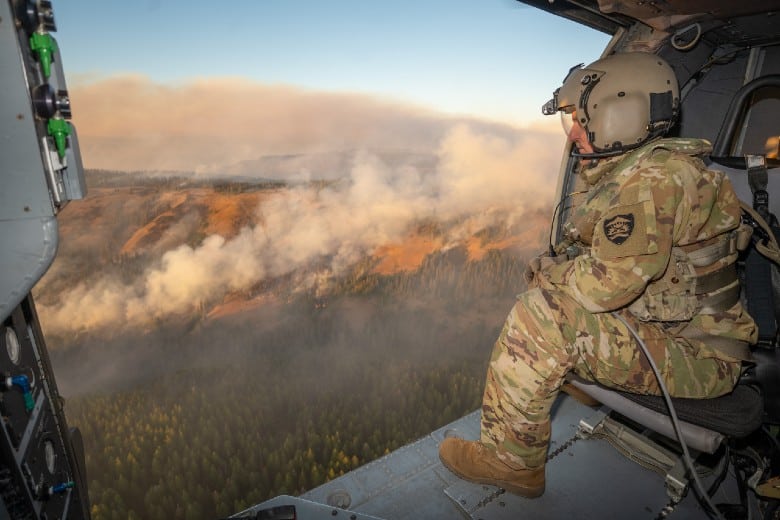
Hagen Fire: Oregon National Guard fights from above
By Terry Murry on Saturday, August 15th, 2026 in Columbia Basin Top Stories More Top Stories
PENDLETON — (News release from the Oregon National Guard) Inside the cabin of an
HH-60M Black Hawk, Staff Sgt. Kyle Sanders leans out over the open door, eyes locked
on a water bucket swinging 100 feet below the aircraft. The pilots up front can’t see it,
since their view is forward, not down, so they rely entirely on Sanders and a Cal Fire
liaison in the cabin for situational awareness of exactly where that bucket is and when to
let it go.
With the release in hand, Sanders times the drop as smoke curls up into the cabin. The
aircraft he’s flying in was built for something else entirely: pulling Soldiers off a
battlefield within the “golden hour” that gives the wounded their best chance of survival.
On Aug. 10, 2026, its mission was different but no less urgent, saving homes instead of
Soldiers, fighting the Hagen Fire in Umatilla County.
Sanders, a crew chief with Golf Company, 1st Battalion, 189th Aviation, has spent 26
years in the Oregon Army National Guard. Until two days before this flight, he’d never
actually dropped water on a fire.
“I’ve been training for 20 years to do this,” Sanders said. “Every fire season, I always
end up on a search and rescue medevac standby crew, or the two or three seasons
where I was actually on a bucket crew, we showed up at the tail end of the fire and just
never got launched.”
Sanders said the moment he finally saw water leave the bucket for the first time stuck
with him.
“I had a smile on my face. I was like, dude, this is freaking awesome,” Sanders said. “I
texted my buddy, my mom, my dad and my wife.”
One of the day’s more demanding moments came when the crew was called in on a
spot fire discovered by their Cal Fire liaison, well outside the fire’s established perimeter.
“We had a small dip site that was about six feet deep of muddy water, and it was a
confined area that was difficult to get in and out of, and it was super smoky with lots of
wind pushing the smoke in our direction,” Sanders said. “Our Cal Fire representative
saw a spot fire that was well into the green, and their ground crew said, ‘Yeah, that’s a
priority.'”
The crew attempted what’s known as a spot drop, bringing the aircraft to a near-hover to
place water precisely on the flames.
“Our rotor wash was actually blowing the fire up, and the bucket was swinging, so I
couldn’t get the water to go directly where I wanted it,” Sanders said. “But we got two or
three drops that were pretty much dead-on the flaming tree, and we called it in again.”
For most of the day, the crew rotated in and out of Langdon Lake alongside a heavy-lift
helicopter and two CH-47 Chinooks, forming what pilots described as a steady
racetrack pattern overhead the lake.
“That rotation worked out really well,” Sanders said. “Langdon Lake is a huge, beautiful,
deep lake, so it was really easy to pick up water fast and get back down there and drop
it off.”
Not everything went smoothly. On one pass, the crew’s bucket tumbled underwater
during a fill and came up tangled, flying slightly crooked and short of full capacity for the
rest of the flight.
“I was monitoring it throughout the flight, and the valve was operating correctly, and it
didn’t seem like there was uneven pressure on one of the cables, so we just kept
operating it the way it was flying,” Sanders said. Ground crews later found no damage
once the aircraft landed, just a minor malfunction that a second Guard crew
experienced as well.
Chief Warrant Officer 4 Nathaniel Carter, seated in the left seat as pilot in command,
said no two dip sites fly the same.
“You go into the fire and they tell you where they want you to go, and sometimes it’s
more challenging than others,” Carter said. “A lot of it depends on the dip site. Dipping
out of a lake is way easier than dipping out of a little pond.”
Chief Warrant Officer 3 Noelan Smith, also on the flight, said the pilots depend heavily
on their crew in the back of the aircraft to safely place the bucket.
“Communication made it a lot easier,” Smith said. “I’m unable to see anything based on
how this aircraft’s laid out, so I have to trust the guys in the back to get it done.”
Bridging the gap between the aircrew and firefighters on the ground was Joe
Carstensen, a Cal Fire military helicopter manager working his first mission with the
Oregon National Guard.
“My job is to be the subject matter expert for the firefighter side, helping bridge that gap
of what the firefighters are saying on the ground and translating that to the military
aviators,” Carstensen said. “It was a great opportunity for us to come up, get some
experience with you guys, see how you run the program, and hopefully leave a little bit
of knowledge with the guys along the way.”
As of Aug. 10, the Hagen Fire had burned 51,061 acres and was 11% contained,
according to the Oregon Department of Forestry. Firefighters lined and held all spot fires
that had crossed Highway 204 near Spout Springs, aided by drone-mounted infrared
cameras that let fire managers pinpoint hot spots for more targeted helicopter water
drops rather than broader retardant application, given the fire’s terrain and fuel
conditions. Night crews held those gains and continued mop-up work, while daytime
operations shifted toward defensive firing in small sections to build a buffer between the
fire and structures at risk, particularly in the fire’s southern reaches. Crews also
continued hand-digging fire line on a spot fire in steep terrain south of Bingham.
Weather has made this fire season especially difficult, with high winds, low humidity and
high temperatures straining available air resources across the region. Gina Miner,
Oregon Department of Forestry Eastern Oregon Area assistant area director, said the
Guard’s aircraft have helped fill that gap.
“The HH-60 pilots and crews’ work on the Hagen Fire has helped ground crews gain
access in rough terrain and slow the spread of increased fire behavior,” Miner said. “The
aerial water bucket support is an integral part of the complete firefighting system,
working together with ground resources, other air resources and heavy equipment. The
activation of the National Guard has relieved some of this burden, and we are very
thankful for their hard work.”
Statewide, the Oregon National Guard had approximately 140 personnel activated in
support of wildfire operations as of Aug. 13, supporting two CH-47 Chinook and two HH-
60M Black Hawk helicopters flying water bucket missions, along with one HH-60M
helicopter supporting search and rescue. Guard aircrews have completed 632 water
bucket drops so far this season, delivering approximately 676,290 gallons of water,
more water than is held in an Olympic-size swimming pool, with operations continuing.
(U.S. Army National Guard photo by Maj. W. Chris Clyne, Oregon National Guard Public
Affairs) U.S. Army Staff Sgt. Kyle Sanders, a crew chief with Golf Company, 1st
Battalion, 189th Aviation, looks out over the Hagen Fire’s burn scar in Umatilla County,
Ore., as an HH-60M Black Hawk helicopter returns to Army Aviation Support Facility #2
in Pendleton, Aug. 10, 2026.